



New York City Football Club has a box problem. Of the couple of thousand on-ball actions in every soccer game, it’s the ones closest to the goal that settle the score. The Pigeons are struggling to find an advantage in either box in 2026. Despite dominating shots and possession, New York City’s 2–1 home loss to Charlotte FC continued a trend that goes beyond mere fluctuations in finishing and shot-stopping.
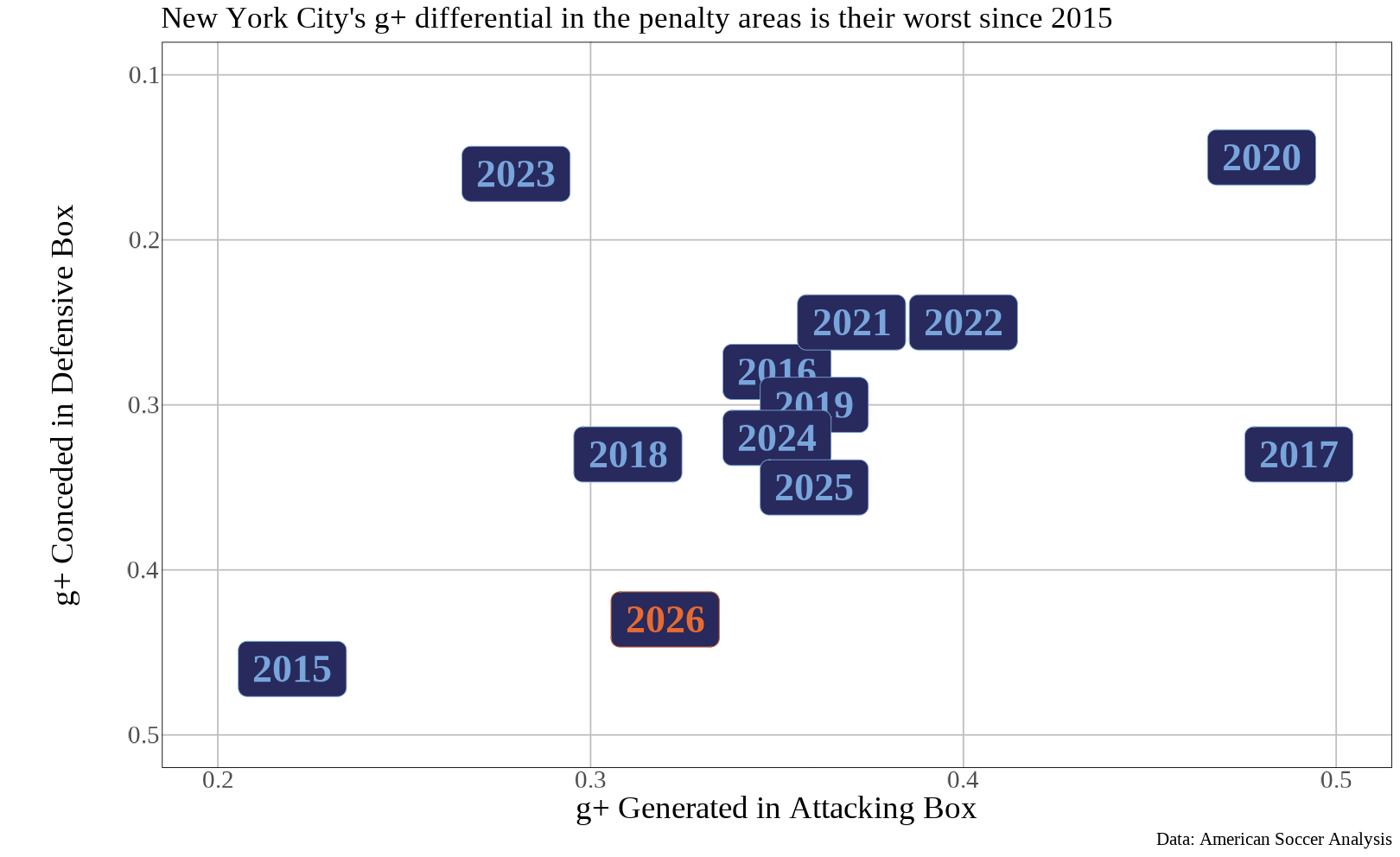
The Pigeons are generating their worst goals-added (g+) differential in the penalty areas since 2015. They would post only their third negative in-box g+ differential in team history if the season were to end today. In-box g+ differential is less predictive than expected goals differential (xGD) or full-field g+ differential, but its relationship to points is steeper. Actions near the goal have an outsized impact on the outcome. Squandering opportunities in either the attacking or defending penalty area is a surefire way to pollute an otherwise strong performance. That is exactly what NYCFC did against Charlotte.
This game appeared firmly in NYCFC’s control, with Pascal Jansen quickly identifying the soft spot in Charlotte head coach Dean Smith’s 4-2-4 mid-block defensive shape. The space behind the wingers, particularly Wilfried Zaha, served as an avenue to build up through with Charlotte center backs Tim Ream and Morrison Agyemang reluctant to come off their line, allowing Nico Fernández Mercau and Maxi Moralez to drop into those wide midfield areas unmarked to receive directly from the backline. In contrast, Jansen’s wingers occupied Smith’s fullbacks. Smith eventually tasked central midfielders Brandt Bronico and Lee Westwood to track NYCFC’s attackers as they dropped wide, but that just opened up Jansen’s midfield pair of Aidan O’Neill or Kai Trewin to receive from the backline with room to turn upfield.
That recipe progressed the Pigeons into the final third with regularity, but the end product was more quantity than quality once they got there. New York City’s 22 shots are the 2nd-largest total under Pascal Jansen, but Smith’s compact and disciplined defensive shape limited those shots to less dangerous positions. At 0.075 xG/shot, NYCFC’s shot quality finished considerably below the league average of 0.124 xG/shot for the past two games.
Jansen’s defense similarly controlled the game during Charlotte’s possession. Like Smith, Jansen kept central defenders Raul Gustavo and Thiago Martins at home as Charlotte’s danger men, Pep Biel and Wilfried Zaha, dropped into midfield. NYCFC diligently rotated their marking to either put left back Kevin O’Toole in pursuit or sag one of Trewin or O’Neill, leaving Westwood unmarked as Charlotte’s deepest-lying midfielder. Slow to turn upfield and vulnerable to back pressure from New York City’s front two, Westwood was enough of a threat that Jansen ultimately dropped Moralez into midfield to deal with these overloads. Jansen deployed this tactic against Vancouver as well, but saw greater success in shutting down the midfield against Charlotte.
New York City dominated defensively in the first half, preventing a single shot from Charlotte. While Charlotte generated only seven shots in the second half, the Pigeons’ first-half supremacy faltered late, and momentary lapses allowed chances from high-quality positions to arise. New York City conceded their highest xG/shot of any game in 2026, two of which decided the game.
Tweaking Moralez’s defensive posture afforded Charlotte’s center backs more time on the ball. Agyemang used that time in the 54th minute to chip a ball toward striker Idan Toklamoti at the halfway line. Biel pulled Trewin up into the midfield overload and left NYCFC out of position for the second ball, easily collected by Zaha. The possession moved wide but quickly came back inside to Zaha, who beat three Pigeons as Toffolo and Toklomati got in behind Ojeda and Gustavo, respectively. Two passes later, and Toklomati, goalside of Gustavo, gave Charlotte the lead.
Zaha was at the center of Charlotte’s second goal too, this time mesmerizing O’Neill and right back Tayvon Gray to neither step to the Ivorian nor track Biel’s run between them. That lapse opened up a simple through ball into the box, and a low cross from Biel reached Kerwin Vargas on the opposite side of the penalty area. The right winger calmly dribbled inside fellow substitute Talles Magno and picked out the side netting.
Jansen’s desperation to chase a goal played a part in the breakdown. Pulling Gustavo left New York City with a single central defender for the final 15 minutes. But this play echoes a 63rd-minute sequence, when the Pigeons still had a full backline, in which Zaha again distracted the NYCFC defense as Toffolo advanced to his left. An early, low cross from Toffolo managed to reach right winger Rodolfo Aloko on the other side for the same cut-in-and-shoot.
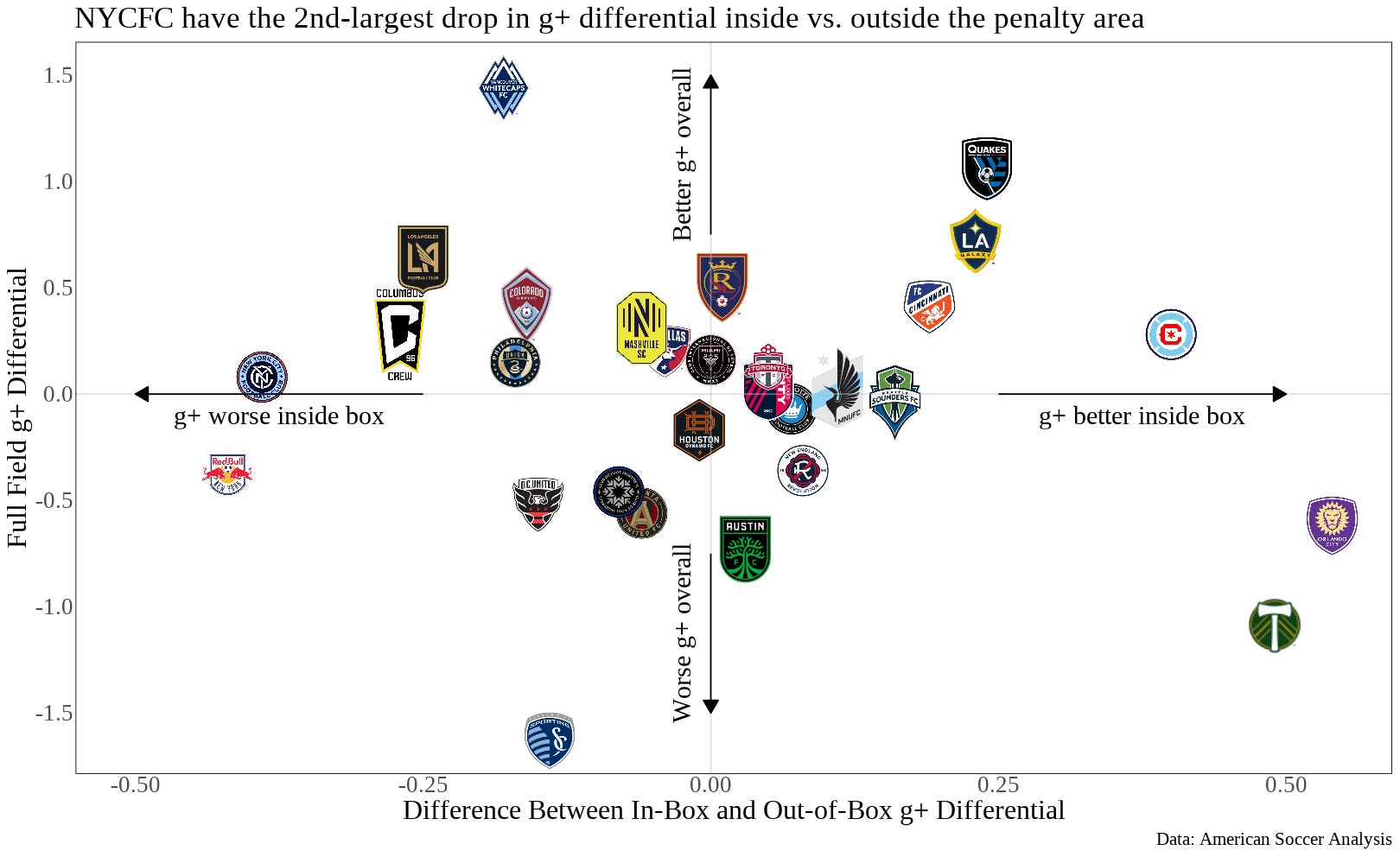
Regardless of the circumstances, teams will punish defensive mistakes like these in and around the box when they happen often enough. New York City, 20th in g+ conceded in their own penalty area, is leaving itself exposed for punishment. On the other end, Jansen’s team ranks 23rd in g+ generated in the attacking box and is struggling to create gaps to punish themselves.
Only the Red Bulls have a larger discrepancy between g+ differential inside vs. outside the penalty areas, a reminder that whatever the quality NYCFC shows across the pitch, they capitulate near the goal. Enough ink has been and will continue to be spilled on the teams’ lack of a true center forward, and addressing that roster hole may mitigate half of this problem. But with the winless streak now at four games, Jansen doesn’t have time to wait for a striker to save the day. Nor would that striker resolve the concerns in the other penalty area. ❧
Image: John William Waterhouse, Pandora