



“The first goal in the game is a massive thing in our sport,” New York City Football Club head coach Pascal Jansen said after Sunday’s match against the Columbus Crew. He’d presumably admit the weight of front-running is even more important when you haven’t won in seven games, a stretch in which the Pigeons had the 8th-worst non-penalty expected goals (npxG) differential in Major League Soccer.
Needing a quick start to stem the tide against the Crew, Hannes Wolf scored early. Then he did it again five minutes later, and suddenly New York City had room to breathe. By the time Wolf scored his third goal in the 66th minute, completing the 4th open-play hat trick in team history, NYCFC had run far enough ahead of Columbus to secure the three points.
The shots (11 to 9) and xG (1.22 to 1.17) were fairly even across the 90 minutes, suggesting the 3-0 scoreline may flatter the performance. New York City displayed attacking creativity, particularly in an even game state, that had been missing in the loss to D.C. United. It wasn’t the comprehensive performance Jansen demands, but it was a start.
The Pigeons read the Crew defense well, identifying gaps and presenting different looks in the attack when Columbus head coach Henrik Rydström adjusted. Steven Zawadski and Rudy Camacho ostensibly marked the attacking front two of Nico Fernández Mercau and Maxi Moralez, but the Columbus central defenders were indecisive in how far to step off their line. When Zawadski and Camacho left the Argentine attackers to drop into space unmarked, New York City played directly to them from the backline with Dylan Chambost overloaded as the lone defensive midfielder. That combination generated the first goal. If the Crew center backs instead pursued Fernández and Moralez into midfield, NYCFC wingers Agustín Ojeda and Wolf ran into space behind. They offered a verticality that this attack sorely missed.
The hat trick was the headline, but Wolf’s off-ball movement was crucial to how NYCFC opened up those spaces in the attack. Columbus right back Steven Moreira tended to track his Austrian counterpart, and Wolf found opportunistic moments to pull him inside to create space for an attacking run from left back Nico Cavallo, who beat Columbus winger Max Arfsten up the flank regularly. The second goal showed it most clearly: cascading defensive breakdowns from the Crew conceded the channel to Cavallo and left Fernández unmarked on the underlap.
Chances were limited throughout, but even picking apart a defense that ranked 4th in MLS in xGA is a promising sign. The Crew’s possession-heavy style was also convenient for Jansen. It let him simplify the game plan, shore up the defensive structure, and choose when to push numbers forward.
The two early goals afforded Jansen the chance to lean into a counterattacking style. Columbus controlled 64% of possession from the 20th minute until half, but only generated 0.24 xG and 3 shots from it. Henrik Rydström’s team continued its possession binge into the second half, but the Crew’s intricate passing often couldn’t escape NYCFC’s collapsing defensive shape. The Pigeons were at their most vulnerable from 45’-60’, a stretch during which Columbus created 62.4% of their xG. The Pigeons survived the onslaught, though Jansen admitted his team was “lucky with that miss at the back post” on a Max Arfsten chance, the Crew’s biggest of the day and one that would have brought the score to 2-1.
Three days later, against Charlotte, the lineup and the story were the same: an early goal put NYCFC in control and allowed the Pigeons to come away with three points and their second road victory of the season. The key adjustment was pushing Cavallo much higher in possession, which allowed Wolf to tuck inside.
On the lone goal of the evening, Cavallo dragged Charlotte’s Nathan Byrne wide, and Wolf drew attention from right center back Morrison, opening a lane for Moralez to play over the top to Ojeda, who had drifted from the left to make the vertical run in the right channel. Some ball watching by left center back Tim Ream left Wolf unmarked in the middle, who promptly reversed to Fernández Mercau. The Argentine DP, isolated 1v1 against left back David Schnegg, cut inside and finished on his left foot.
Kristijan Kahlina’s handling error gifted Fernández Mercau the goal, but the sequence was still remarkable for the Pigeons. Every single player, fullbacks excluded, contributed to the beautiful 11-pass sequence through the middle of the field for a high-quality scoring opportunity on the doorstep of the goal. More importantly, scoring and gaining the lead before the 10-minute mark let NYCFC, knowing that Charlotte would have to chase, make the game ugly — a huge boon for a team on the road. The two sides barely combined for over 1 xG, and featured just as many yellow cards (9) as shots-on-target.
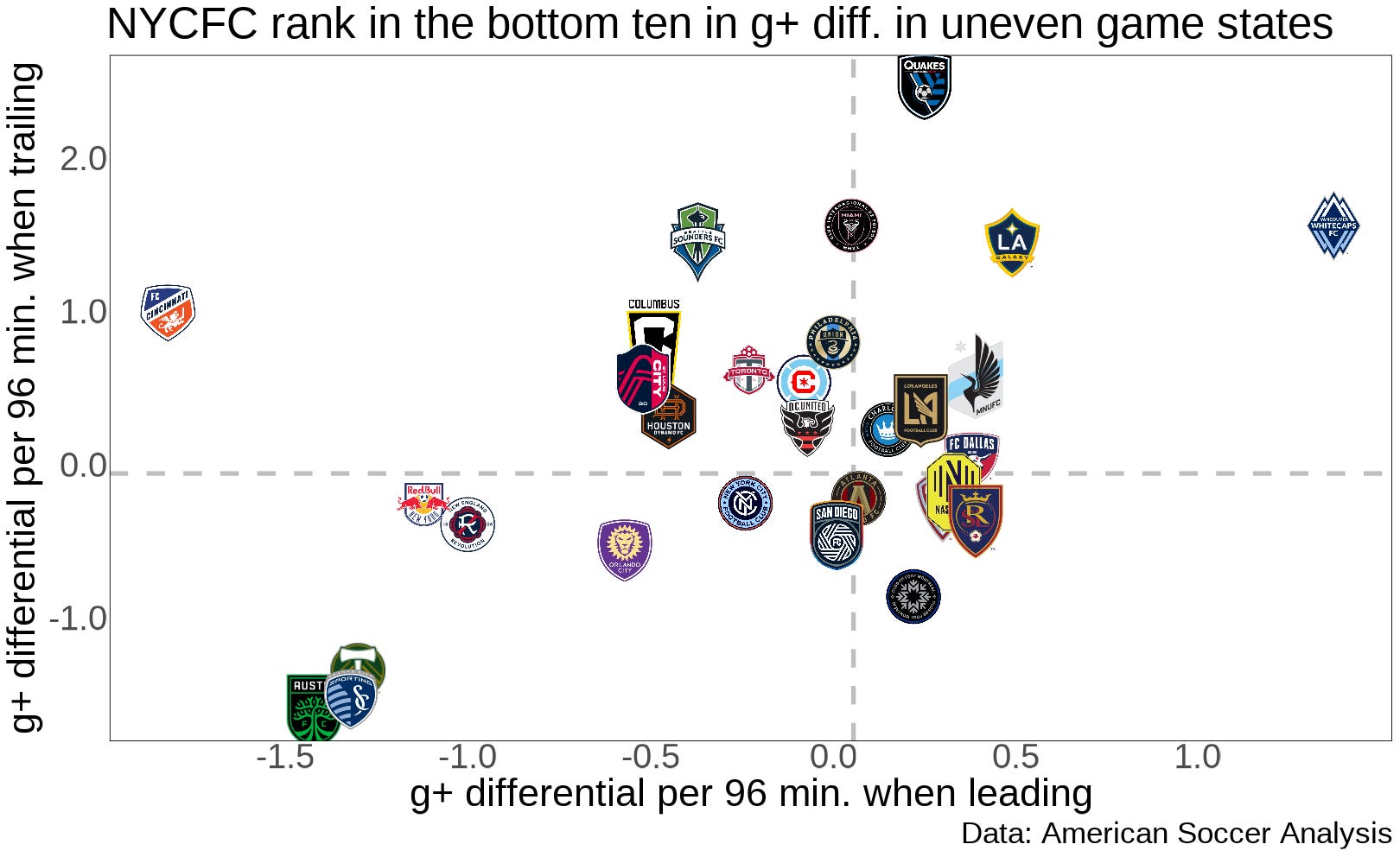
Luck and game state are variables that dramatically swing matches in soccer. New York City was a victim of both during their now-vanquished seven-game winless streak, but was aided by them in both games. Sometimes, those are the nudges teams need to elevate pedestrian performances into impressive results. They are also nudges that New York City should strive to become more resilient to, as their g+ differential ranking drops from 7th to 22nd/20th from even game states to losing/leading game states, respectively. For now, they just take the wins. The Pigeons needed something powerful to wash the sour taste of a nearly two-month winless streak from their mouths, and a pair of clean sheet victories, regardless of how you get there, is as close as you get to a fire hose. ❧
Image: Leonard Rosoman, A House Collapsing on Two Firemen, Shoe Lane, London, EC4