


An Argentine short king was always going to define the match between New York City Football Club and Inter Miami. For one half, it wasn’t the ones everyone expected. Nico Fernández Mercau became the headline, bending a free kick into the top corner that will be one of the best you will see this season. Then, Maxi Moralez and Agustín Ojeda made their mark, connecting on a transition through ball down the heart of Miami’s defense for a goal to put the Pigeons ahead. But for every moment of magic from Fernández Mercau and Moralez, Lionel Messi always had a reminder that he is the king of short kings.
Messi immediately responded to Ojeda’s goal with a free kick that deflected past keeper Matt Freese to tip the momentum back in Miami’s favor on their way to a 3-2 road victory. It was miraculous that he didn’t do more damage: nine shots, four on goal, another two off the woodwork. The lone player singlehandedly capable of opening up the upper decks at Yankee Stadium, the only thing that Messi attracts more than defenders is attention. His greatness is so regular that there is little point in dwelling on it.
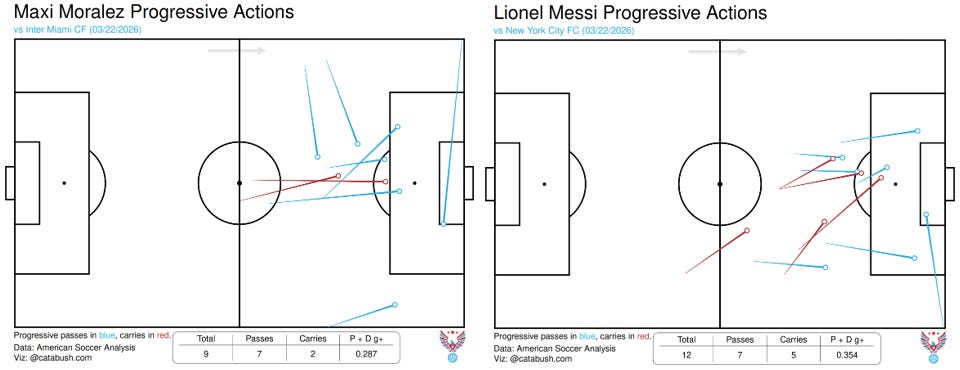
That Messi dominated and NYCFC struggled to stop him is not the story. Head coach Pascal Jansen’s decision not to deploy a man-marker, as he had with center back Kai Trewin against Colorado’s attacking midfielder, defined the match for the Pigeons. Maybe Jansen thinks Paxton Aaronson warrants man-marking more than the greatest of all time? Probably not.
It’s plausible Jansen concluded that man marking someone casually strolling around the field like a retiree enjoying the birds, oftentimes 10 yards offside, isn’t exactly intuitive. But Messi’s “if I don’t move, maybe they won’t see me” approach lulled New York City defenders to sleep as he drifted into pockets, the tide of the game ebbing and flowing around him. Quick combinations set what was immobile into motion. By then, it’s too late, and the backline is wondering how the sweet old man strolling through the park acquired a weapon and is now sprinting at them with it.
Miami didn’t even need Messi dropping into midfield from his false nine role to establish control. A casual 2-minute passing sequence at the start of the game took the bite out of the Pigeons’ ability to high press with barely a touch from Messi. Tadeo Allende and Mateo Silvetti sat wide in possession, held the backline high, opening central space and making Miami’s buildup look effortless. That ease of possession culminated in a Gonzalo Lujan second-phase corner goal, forcing Jansen to adopt a more conservative mid-block defensive shape.
While Jansen chose not to man-mark his opponent’s diminutive Argentine attacker, Javier Mascherano (or the lieutenant he was puppeteering) did. Twice over. Fernández Mercau and Moralez again operated as NYCFC’s front two, and Miami central defenders Micael and Lujan never let them feel lonely. The always-savvy Moralez tested the limits of their marking, seeking out space deep and wide where he could run point. Fernández Mercau mimicked his Argentine elder, and both were able to get on the ball despite Miami’s man-marking attempts, ranking 4th and 6th, respectively, in touch percentage within their position this week. Successful progressions from the back often featured attackers dropping in to receive directly from the backline. But Mascherano’s man-marking tactic kept breaking those chains before they could reach the final third, and NYCFC’s buildup couldn’t sustain without Fernández Mercau and Moralez in the same way that Miami’s could without Messi.
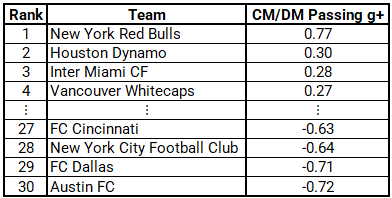
Aidan O’Neill and Keaton Parks rarely supplemented buildups through the midfield as New York City struggled to build up through the 4-4-2 pressing shape, even with Messi merely existing as a traffic cone. Through five games, NYCFC central and defensive midfielders rank 28th among 30 MLS teams in passing goals added (g+), according to American Soccer Analysis, highlighting the fact that only two MLS teams have gotten less from the middle of the field.
Despite ranking 5th in possession for the season, NYCFC continued to struggle controlling the game with the ball when not buoyed by man advantages. That red card trend should have continued in the 76th minute when Miami keeper Dayne St. Clair handled a Moralez ball over the top outside the box. Miraculously, in a stadium full of cameras, none captured a conclusive angle that would warrant a review of the non-call. St. Clair’s blunder should have put the Pigeons a man up and in control of the ball to put their gamechangers in position to do something special yet again. Instead, the Pigeons continued to possess at the 44% rate they maintained all game, despite trailing for the final 20 minutes after Micael’s second-phase corner kick goal.
The Outfield’s Justin Egan asked Jansen after the match whether he was concerned his team had lost the possession battle for the second consecutive home match. He responded with an emphatic “not at all”, nothing more. But Jansen’s 76th-minute substitution of Parks for Jonny Shore is an admission that the midfield needed work. For all of Parks’ threatening activity as a pseudo-striker, his impact will need to be felt in the center of the pitch to get back to their ball-dominating ways.
The defending MLS Cup champions provided the best bellwether for NYC early in 2026. This match confirmed the Pigeons are a second-tier contender in the Eastern Conference, but it showed that their Argentine short kings can keep them in games against anyone in MLS. While they may not be Messi, Fernández Mercau and Moralez have accounted for 10 of the team’s 19 goal contributions and 42.3% of their expected goals and assists. They are more than capable of moments of magic to compensate as the buildup finds its footing, and of dragging their team back into battles like this. It just wasn’t enough against Messi on this day. ❧
Image: Benjamin Robert Haydon, Napoléon Bonaparte (‘Napoléon on St Helena’)