



Soccer managers are contractually obligated to tighten up and switch to conservative tactics when protecting a one-goal lead late in games. It’s a tale as old as time. A team enters the last 15-20 minutes of the match up a goal, and you can see eleven sets of buttcheeks clench in real time. Here comes the bunker, and hold on for dear life.
New York City Football Club puckered against St. Louis City and was punished for it. Substitutes Lukas MacNaughton and Brendan McSorley combined for an equalizer six minutes into stoppage time, spoiling a Hannes Wolf goal that had given the Pigeons the lead in the 50th minute. NYCFC’s defensive block continued to recede towards the goal, so MacNaughton received little pressure on the edge of the final third when he sent an in-swinging ball to the near post. McSorley headed it past keeper Matt Freese to seal the 1-1 draw and steal a point on the road.
St. Louis’ goal culminated a tumultuous final stretch for New York City, with the visitors generating 7 of their 14 shots and 58% of their 1.20 expected goals (xG) in the final thirty minutes of the match. This is the second time early in 2026 that NYCFC conceded late, nursing a one-goal lead. Tayvon Gray bailed them out the first time with his 99th-minute winner vs. Philadelphia, but the bunker keeps springing leaks.
Six games isn’t the most reliable sample, especially when that data is split into 10-minute chunks, but approximately 20% of New York City’s xG conceded in 2026 occurred after the 85th minute. That stretch was also the Pigeons’ worst 10-minute increment in head coach Pascal Jansen’s first season, though xG is generated at a higher rate league-wide from the 86th minute onward, so the 2025 number tracks with the norm.
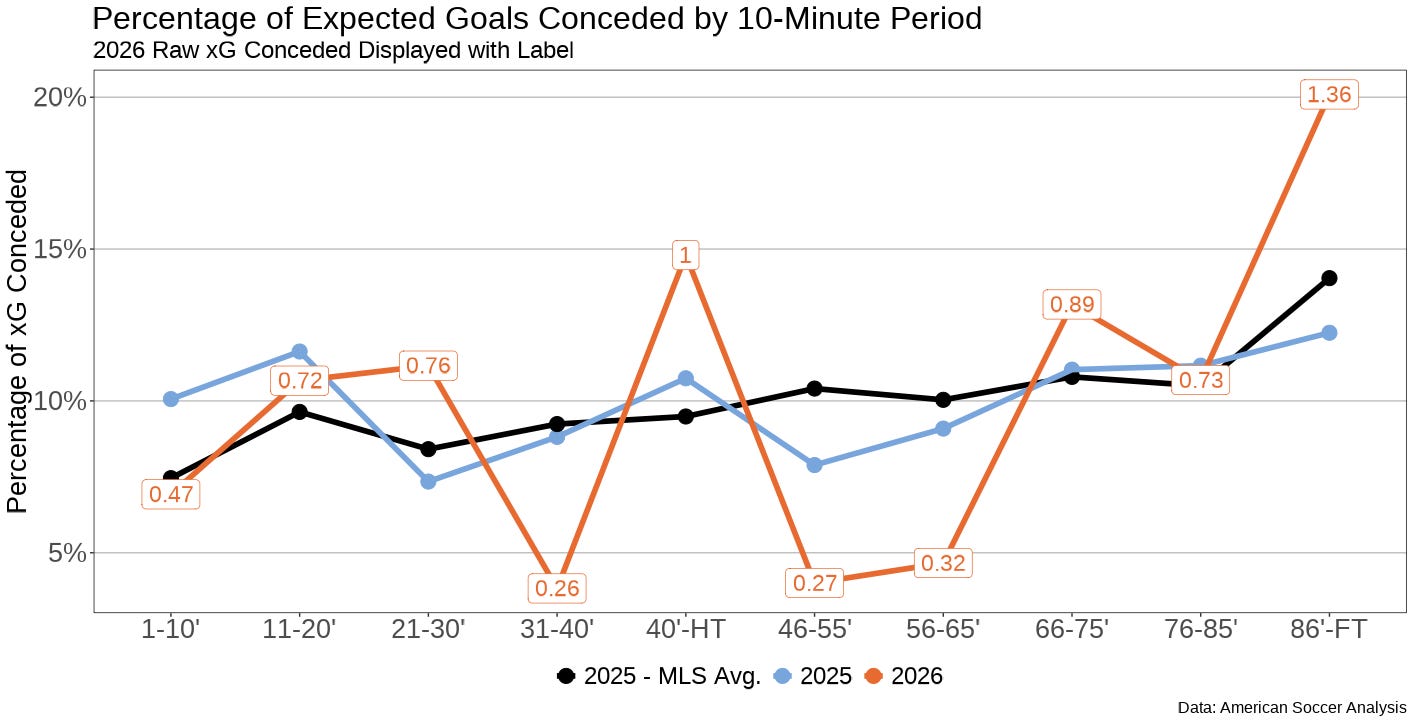
Nevertheless, the chaotic nature of the final minutes vs. St. Louis illustrates the risks of adopting a defensive shell rather than continuing the style of play that got you the lead in the first place. New York City controlled 58% of possession throughout the game but struggled to retain it late in the game. Whether it was a conscious decision to let St. Louis City head coach Yoann Damet’s team control possession or an inability to withstand their increased pressure, Jansen did what all managers do. He clenched.
With the score 0-0, Jansen’s team built up through St. Louis’ 4-4-2 mid-block with composure. Former NYCFC academy product Dante Polvara and fellow central defender Timo Baumgartl were indecisive on how aggressive to track Maxi Moralez and Nico Fernández Mercau upfield, even after Damet’s halftime switch to a 5-4-1 defensive shape to give an extra man in the backline. The savvy attacking front two for New York City’s savvy front-two exploited that hesitation, finding pockets in between the lines with regularity. Their ability to get on the ball with space to turn gave St. Louis fits throughout the first half and was influential in New York City’s goal. Wolf, Moralez, and Fernández overloaded Polvara while St. Louis’ other center backs failed to step into midfield in support. As soon as Wolf received from Parks, a quick rush towards goal and a 1-2 between Wolf and Moralez eliminated Polvara, sending the Austrian into the box to slip it past keeper Roman Burki.
But New York City’s 66/34 passing advantage in an even game state evaporated to a 47/53 split after the opening goal. By the time McSorley scored, the team looked different, in approach and in personnel. Jansen revamped his backline by bringing on two defenders in Raul Gustavo (76’) and Nico Cavallo (89’), and testing Kai Trewin out at right back. Upon Cavallo’s introduction, another defender, Kevin O’Toole, moved into an unfamiliar midfield role to pair with Jonny Shore, who previously substituted on for Keaton Parks.
Rather than settling into possession, NYCFC regularly cleared to the halfway line, where St. Louis reclaimed the ball and reinitiated their attack. The average length of NYCFC possession chains cratered from 10.7 passing/shooting actions pre-goal to 5.8 afterward. Even for average clenching standards, the Pigeons have adjusted their game more than most when leading by a goal.
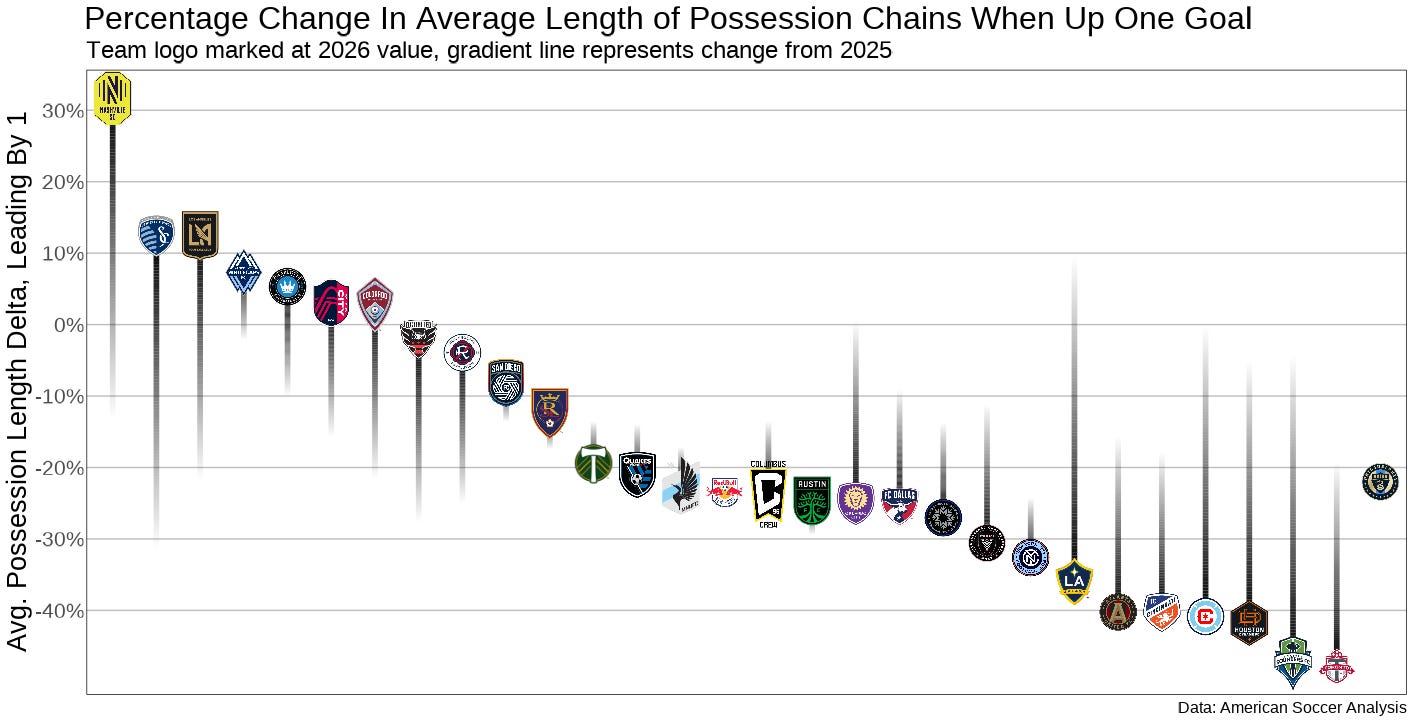
Possession chain length can serve as a proxy for the approach to possession (or resilience in maintaining it), with its value during even game states serving as a baseline to control for default play styles. The league-wide average length of possession chains decreased by 14.9% relative to baseline in 2025 when up a goal.
The Pigeons exhibit one of the largest decreases in this metric under Jansen. The average New York City possession is 32.6% shorter (i.e., fewer passing/shooting actions) in 2026, the 8th-largest decrease in Major League Soccer, when leading by one. That continues a trend from 2025, when Jansen’s team ranked 6th in the league in this category at 24.3%.
Continuing this trend against St. Louis is on brand but not necessarily to blame for the result. The other side of the coin with a bunker scheme is that it usually offers ample opportunities to counter when the opponent pushes for an equalizer. That was the case vs. St. Louis, with the visitors sending numbers forward so much that Fernández dribbled in on goal from the halfway line at one point. But NYCFC could not find the goal that would have put the game out of reach despite 5 shots and 0.69 xG from the 86th minute onward.
New York City created just as many chances as St. Louis in the final ten minutes of the game. Still, by forfeiting possession, they left themselves exposed to random variations of finishing. McSorley’s late goal leaves a sour taste after NYCFC looked comfortable for the majority of the match. It stings more because St. Louis doesn’t deserve nice things until they cut it out with this silly “CITY” capitalization. Jansen is a tactical chameleon, and altering his approach when he’s holding a lead is true to style. But against St. Louis City, it bit him. ❧
Image: Edward Hopper, Automat