


I have always loved the World Cup. It has given me some of the best sports memories I've had as a fan of this game. On a warm night in Qatar, nearly four years ago, Argentina and France competed in one of the most exciting finals I have ever watched. It was the coronation of one of the greatest players of all time, Lionel Messi, and a breakout moment for one of the best players of this new generation, Kylian Mbappé.
But the more I examine it, the harder it is to ignore what surrounds it. Those same games were shadowed by Qatar's human rights record, the abuse of migrant workers, and corruption in FIFA's selection process. And while FIFA's president Gianni Infantino would prefer that critics "just focus on football," it is hard to ignore FIFA’s long history of complicity, and this was not the first time FIFA has looked the other way.
During the 1938 World Cup final in France, Benito Mussolini compelled the Italian team to give the fascist salute during their national anthem. After Italy won, Mussolini had the trophy brought to him. In 1978, Argentina hosted the tournament under a military junta that had overthrown Isabel Perón's elected government. This prompted boycott calls from nations and human rights groups who noted that detention centers operated within miles of the stadiums. The 2010 South African games drew allegations of bribery and pre-tournament match fixing. Those charges were among the findings that led to a US indictment of over two dozen FIFA executives in 2015. In 2018, the games in Russia followed the 2014 annexation of Crimea, with several governments and human rights groups calling for a boycott that never came.
FIFA has always chosen profit over principle. In 2026, that choice is playing out in American cities.

Beginning January 1, 2026, the US imposed complete or partial travel bans on 39 countries. Players from those nations remained exempt as per the law, but their fans were not. Two weeks later, the Trump administration suspended visa processing for another 75 countries, further narrowing the pool of fans who can travel. In December 2025, the State Department added a social media screening requirement for all ESTA applicants, covering five years of posts: anyone deemed to hold a hostile attitude toward the USA could be denied entry on that basis alone. This has already affected the games themselves. Africa's reigning Referee of the Year, Omar Arten, has been denied the ability to officiate at the tournament. The Trump administration has not cited his Somali nationality as the reason. It doesn't have to.

During the Concacaf Gold Cup and FIFA Club World Cup, both hosted in the US, ICE was reported outside stadiums attempting to identify and deport undocumented immigrants following matches. Meanwhile, President Trump has repeatedly invoked his authority to strip World Cup matches from cities he deems unsafe, using the tournament as a lever to force compliance with his immigration agenda. On Monday, right before President Trump fell asleep before 10 pm during Game 3 of the NBA Finals at Madison Square Garden, Border Czar Tom Homan announced an unprecedented surge of ICE officers into New York City, the host city of the final, responding to Governor Kathy Hochul's legislative efforts to shield residents from federal immigration enforcement.

On February 28, 2026, Trump initiated military action against Iran. Trump posted that he didn’t believe it was “appropriate” for Iran to attend, citing concerns for “their own life and safety,” a veiled threat from a sitting president toward a nation he had just attacked. Since then, Trump has allowed the Iranian national team to enter the US, but a number of team staff have been denied entry for “security reasons,” including the head of the federation, his deputy, and the team’s media director. The team itself has been required to base itself in Mexico, permitted to cross the border only the day before each match. And now, on the eve of the tournament, Trump has announced the reignition of military action against Iran following a failed ceasefire.
FIFA’s own mission statement calls for promoting football “in the light of its unifying, educational, cultural, and humanitarian values.” It is difficult to read that sentence in 2026 with a straight face.
Infantino’s relationship with Trump goes well beyond diplomatic courtesy. During the FIFA Club World Cup, Infantino handed Trump a medal on stage amid a victorious Chelsea squad as Chelsea captain Reece James lifted the trophy. It was later reported that FIFA gifted that trophy to the White House, and Chelsea received a replica.
During a meeting at the White House with Infantino in June of last year, Trump disparaged trans athletes’ participation in gendered competition, pressing a position FIFA’s governing body has historically avoided taking.
The most egregious appeasement came with an inaugural FIFA “Peace Prize,” given to quell Trump’s frustration at his inability to win the Nobel Peace Prize. This size-mandated prize marked a stark shift from the “let’s focus on football” mantra of the Qatar games to the geopolitical meddling of this one. The allegations of a quid pro quo hardened when, after the prize was awarded, a bribery case against FIFA was dropped at the behest of “a Trump official” in the Justice Department.
The US team and its federation have given fans their own reasons for pause. For years, the U.S. Soccer Federation has consistently drifted right, in part as a response to pressure from the more progressive U.S. Women’s National Team. Some players have leaned in. Others have been pulled along. Star player Christian Pulisic came under fire for doing the “Trump Dance” after scoring against Jamaica. Pulisic tried to walk it back, but former teammates were critical of the gesture.
Both Tim Weah and Weston McKennie were invited to the White House on June 18, 2025, as part of a Juventus delegation, where Trump, with the two USMNT players as a captive audience, held forth on Middle East policy, Joe Biden's "Auto-pen," the federal minimum wage, and the prospect of transgender athletes joining the Juventus team. McKennie and Weah seemed uninterested in the political theater.
Weah later said, “It was all a surprise to me…they told us we have to go…I had no choice. It was a bit weird…I’m not one for politics. I just want to play football, man.”
FIFA’s “forget about politics” posture has a simpler explanation: it is, at its core, a money-making operation, and has never been shy about using politics to protect its margins. While FIFA is registered as a not-for-profit organization, it makes billions off the World Cup. As outlined in the 2018 bid, tickets for the USA, Mexico, and Canada would average between $60 and $1,500. Tickets are averaging between $380–$4,150, nearly six times the original low-end estimate. The gap is so wide that U.S. lawmakers had to compel FIFA to honor the originally stated $60 floor. Those $60 tickets, where they exist at all, are vanishingly few. Less than three weeks from kickoff, New York Attorney General Letitia James and New Jersey Attorney General Jennifer Davenport announced a joint investigation into World Cup ticket pricing, stating that fans have been misled on pricing.
It’s hard to watch the game I love get swallowed by the politics of people I find reprehensible. And while it is equally irrational to believe that every place the World Cup will ever be hosted will share my values, I’m struggling to accept that it’s my country’s turn to contribute to this revolving door of moral bankruptcy. The governing body is corrupt, the host nation is involved in war crimes, and the team seems to have adopted Laura Ingraham’s “shut up and dribble” approach to politics, rather than oppose human rights violations done in the name of the badge it plays for. The US, under Trump, is murdering citizens on the street in major cities, conducting warrantless searches and seizures on people’s property, and creating an anti-immigrant policy and enforcement akin to that of the Third Reich.
So, while I will still watch the games, I cannot say I am excited to do it, and I find that sad. I love this sport. I love what it can be and what that night in Qatar was, briefly. But I’m struggling to root for my team, I’m struggling to be proud of my country, and right now I’m not sure those two things can be separated. ❧
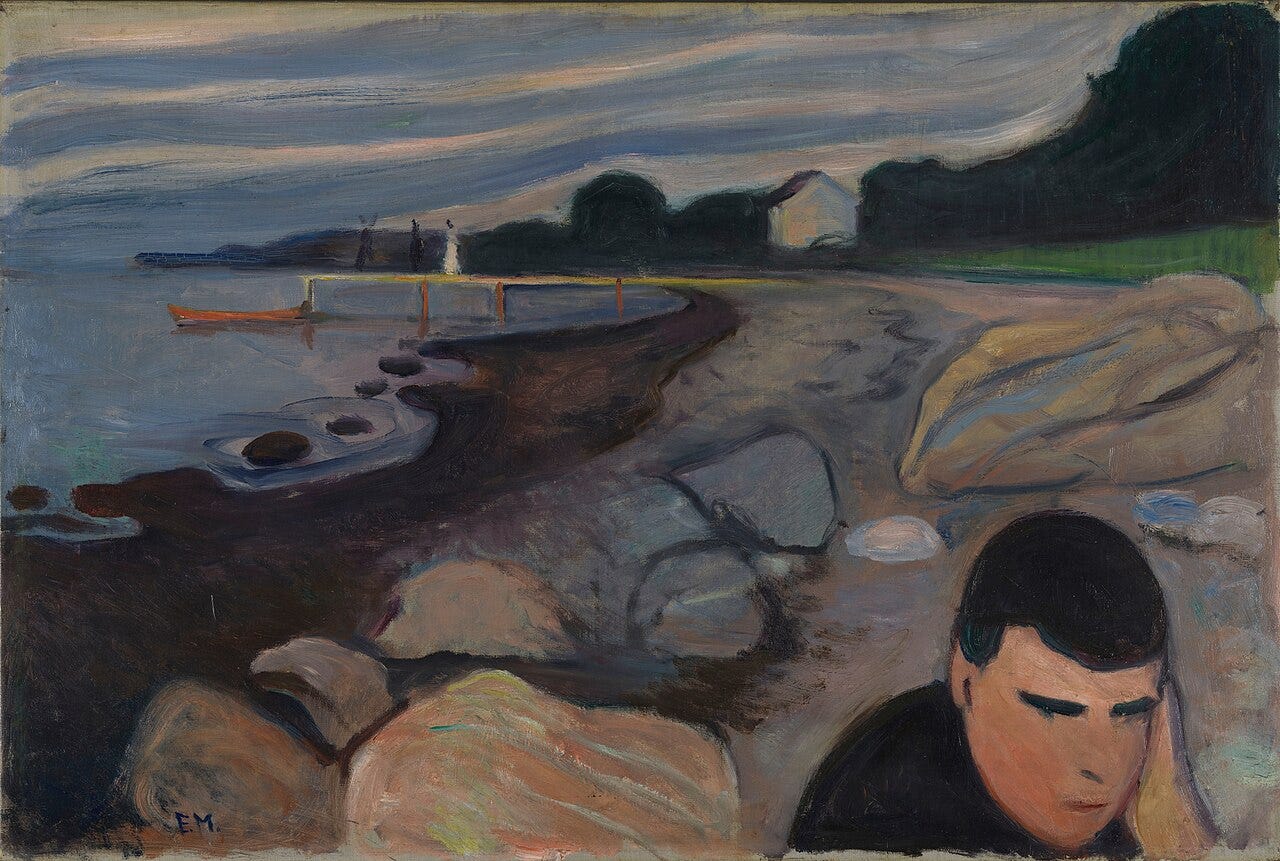
Image: Edvard Munch, Melancholy